Your GPS is lying to you
One way to become internet famous is to mistype your destination in your map app and accidentally follow the windy roads to the farthest corner of Iceland. This is what Noel Santillan did on a 2016 vacation – driving his rental car an extra 430 km/six hours to a farflung town whose name was identical to his hotel in the capital, only with one extra R. Whoops! You may have heard the story.
This tale is funny and we can all imagine it, because we all type our driving destinations into our map apps continually, almost daily. It’s how we navigate.
Thousands of words have been written on this topic: on the lost art of map reading, our inability to navigate our way out of a paper bag without GPS, the bygone skill of asking a gas station attendant for directions IRL when lost. And these things matter, but they’re not the center of the issue. The crux is the me-centrifying effects that sat-nav practices have on our souls. These come from the subtle messages GPS navigation convey about our position in place… and time.
In her poem, “Maps,” Holly Ordway writes:
Now GPS puts me right at the centre,
A Ptolemaic shift in my perspective.
Pinned where I am, right now, somewhere, I turn
And turn to orient myself.
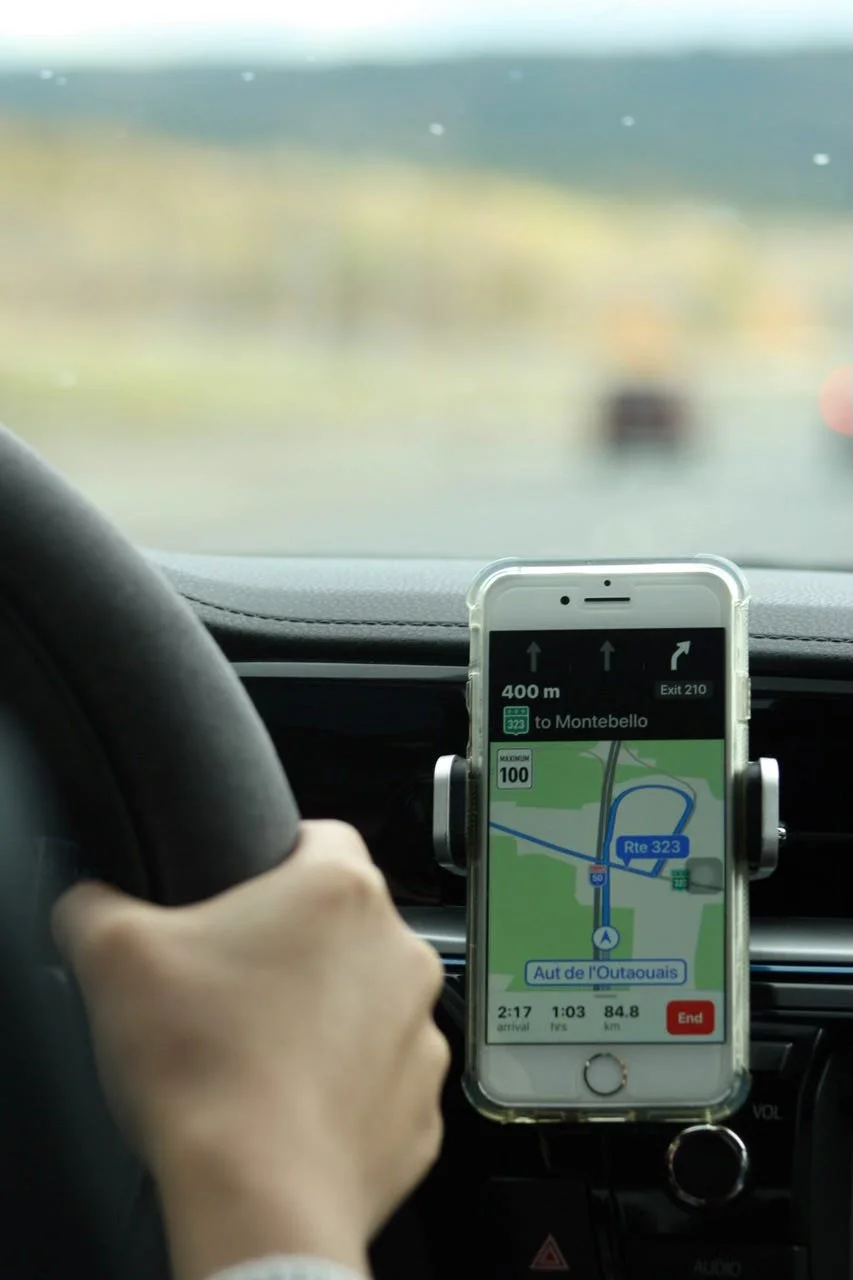
First, place. Ordway says it perfectly: GPS puts us at the center of every map we open on our phone. The blue circle shows us precisely where we are on the earth, at any time. Our handheld device is the axle on which our whole world spins and turns. The slice of the world displayed there is tiny and only relevant to us. Everything beyond our environs is excluded. Nothing else appears on screen, so to us, it does not exist.
As we navigate, the GPS marker moves as we move. “Old” places are discarded and disappear as we sojourn along our path into our emerging locale. Our advancing is the GPS’s command, and terrain closes up behind us as we go. We dwell alone, so to speak, in our square of geography. It’s an anti-expansive picture of being enclosed yet mobile.
Second, time. During our navigation experience we’re told exactly how long it will take to get to our location. If adjustments to our trip become necessary – if we hit traffic or take a detour – our time allocation is modified. The GPS and we reside, together, in this cordoned-off slice of time that exists during our journey. We dwell at the center of this isolated chapter, the minutes partitioned off for us. The number of our minutes float and tick. Time, during our trip, revolves wholly around us.
The narrative of our GPS is: you, individual, are a solo act right at the center of things, and space and time revolve around you.
What are the effects on our souls? Well, we already reside in a culture where individualism is the order of the day, where we each build our own personal brand and are taught to rely on self. Being true to ourselves is the primary “virtue,” we are told. We continually survey our mood and desires to hone in on customized preferences – after all, we have one million song-listening choices on Spotify and viewing opportunities on YouTube or Netflix (among others). Social media adapts itself algorithmically to our preferences without our even asking it to. Self and self.
At the same time, our culture’s sense that we live as part of a larger fabric of society has drastically fallen off. With each decade, our families are less cohesive and more splintered; we act as if radical autonomy were a good (it’s not) and could cause flourishing (it can’t). We’re removed from context and detached in our relationships. We engage with community much less than our forebears did – know our neighbors, participate in the rotary club, attend church with fellow congregants, bowl in the local league. We “bowl alone,” as Charles Murray demonstrates in his book of the same name – way back in 2000, 25 years ago! Before iPhones were out and “rotting” was even a thing. Today the atomization of America and Americans has advanced much further. With that atomization comes isolation from purpose and meaning, which always relate to the needs and realities of other humans and cannot unfold in a vacuum. Or amidst self-focused pleasures and entertainment.
And so our GPS is one more space in which we quietly, subconsciously internalize the message that we’re alone and the thing to heed. We, ourselves. Solitary in our car. As if we were the protagonist in a hero’s journey – except we aren’t actually the hero, and we aren’t on a real journey. Because to be on an authentic hero’s journey, we need a departure from home, a series of trials and challenges to navigate toward purpose, growth, and a return to community in the place we started – this time with maturity, insight, and an ability to give back. We moderns generally have none of that. We’re simply going from place to place, traipsing with self at the center, lacking true purpose or real self-actualizing. We follow the blue line along, passively “oriented,” while remaining profoundly dis-oriented in the important ways. This is what our GPS system reveals. It is the paradox of the modern person; profoundly lost, in key aspects of our humanity, while precisely satellite-located in small slice of irrelevant map.
<Share>
The picture isn’t heartening, but it’s real.
How do we unmake it? How can we reengage as humans, positioning ourselves appropriately in place and time in healthy ways?
It’s not about the GPS itself, in case that wasn’t obvious. GPS is helpful and ubiquitous. So start using paper maps if you like, but the solution relies in a bigger-scale reorientation of place and time. I offer three.
First, we can interact with places outside of our own immediate sphere – our phone, our home, the subscribers we follow on YouTube. This is getting off the couch, literally and metaphorically, and becoming interested in other people’s spaces and experiences. Traveling is one way to do this, whether to faraway places or locally: to a nearby museum or unvisited part of town. Places may be the inside of a town hall at a town politics meeting, a bowling league, a local church.
Second, let’s become people who know and engage with history. When we see ourselves as part of the great narrative of humanity across time and around the globe, we can rightly - and more humbly - understand ourselves. We zoom out from our own era and the minutes encapsulated by the small journeys we take and consider ourselves in the grand sweep of all of time. (This free resource is a great place to start.)
Third, we can consciously diminish self-catering opportunities, especially visual media (social media, You Tube, shows and movies). The less time we spend with our hand on the trigger of our immediate likes, whims, and viewing preferences, the less we’ll be caught up in the “self-as-center” life. In this, we can read worthwhile books instead of watch movies. We can host parties where we focus on others, and welcoming the into our spaces. We can serve others. We can delve into works of theology and philosophy, grounding ourselves in the nourishment of goodness, truth, and beauty. Transcendence, where we are drawn up and out of self, is the solution to being like Narcissus, addicted to our own reflection, image, and wants.
In combatting the addictive tendency to keep ourselves as the center of time and place, C. S. Lewis, as often, has the best advice. He says:
“A man who has lived in many places is not likely to be deceived by the local errors of his native village… the scholar who has lived in many times is therefore in some degree immune from the great cataract of nonsense that pours from the press and the microphone of his own age.”
The “nonsense” pours today from “the press and microphone” of our own minds – the uninterrupted focus, echo, and pursuit of self and individualistic interests. We don’t have to be bound by either the nonsense, or ourselves. We can zoom out in healthy ways: become immune by enlarging ourselves. And we must. GPS may put us all right at the center, but thank heavens we can escape that burden – we don’t have to live that way.
<Duplicated from my Substack.>
Thanks for reading For the Sake of the Good!
Subscribe for free (here, at the bottom) to receive new posts and support my work.
You May Also Enjoy:



Your GPS is lying to you